Movement and force assessment · London
Movement & Force Production Strategy Assessment in London
Connect how you move with how you produce force to make your physical training more individual.
Biomechanical Assessment shows the movement options and strategies available to you. Force plate testing shows how you use those strategies when you need to absorb and produce force.
- Price
- £400
- Duration
- 2 hours
- Locations
- Liverpool Street · Marylebone
Included in your assessment
Biomechanical Assessment and the Force & Power Profile, interpreted together.
Endurance, resting metabolism and sweat testing are separate assessments.
Booking and preparation
Please book at least seven days ahead. We need this notice to reserve the studio for in-person appointments.
Follow the preparation instructions for your chosen assessment. Ask about Movement & Force Production Strategy Assessment.
Inside your assessment report
Your results are explained in a written report, with recommendations you can use yourself or share with your coach.
Your assessment includes a written report. We confirm the delivery time at your appointment.
Results
Recorded movement measurements alongside the force-plate results.
Interpretation
How the findings from both assessments inform your movement and force-production profile.
Training recommendations
A combined set of priorities for movement, strength and power training.
Movement, strategy and force output.
By interpreting the two together, we can make more informed decisions about both exercise selection and the physical qualities your training should develop. Rather than treating movement and force production as separate results, the assessment shows how they relate within your individual performance.
01The movement options available to youWhat your body can currently get to, and where it cannot.
How we measure it
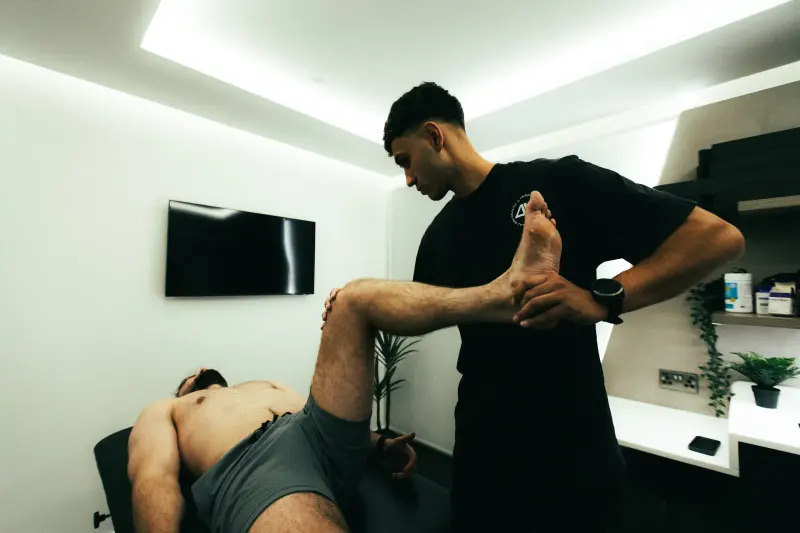
Recorded early and late shoulder and hip measurements at the table, standing strategy analysis, axial compression and reorganisation tests.
Why it matters
Establishes the range your system can organise itself within. A strategy is a solution to the options available — so knowing the options is what makes the strategy interpretable rather than merely observable.
02The strategy you rely onHow you solve a task, and why that solution may be there.
How we measure it
How you manage pressure and shape as load and position change, and where motion is available or restricted between segments.
Why it matters
The aim is not to grade you. It is to understand the strategy you currently use, why it may have developed, and whether it supports or limits what your sport asks of you.
03That strategy under a time constraintWhat happens when there is no time to organise carefully.
How we measure it
Countermovement depth and duration, braking force and impulse, the speed of the transition into propulsion, time to take-off, rate of force development, velocity, power and reactive strength where tested.
Why it matters
A jump gives you a fraction of a second. What you do in it is your strategy with the deliberation removed — which is why the force plates so often confirm, or complicate, what the movement assessment predicted.
04What each limb contributedSide-to-side contribution, read against the movement findings.
How we measure it
Each limb’s share of braking and propulsion across the protocols, phase by phase rather than as a single figure.
Why it matters
A difference on the plates is far more interpretable when the movement assessment has already shown what is available on each side. Where the two agree, confidence is higher; where they disagree, that disagreement is usually the more useful observation.
05Your priorities, in orderWhat to change, and what to change it with.
How we measure it
One interpretation covering both assessments, with a written report and your force-time data.
Why it matters
Exercise selection, positioning, loading, training volume, movement preparation, and the order to develop physical qualities in. Each one is tied to a finding rather than offered as general advice.
This is a performance assessment. It describes how you organise movement and how that organisation appears under speed. It does not diagnose injury and it does not predict it.
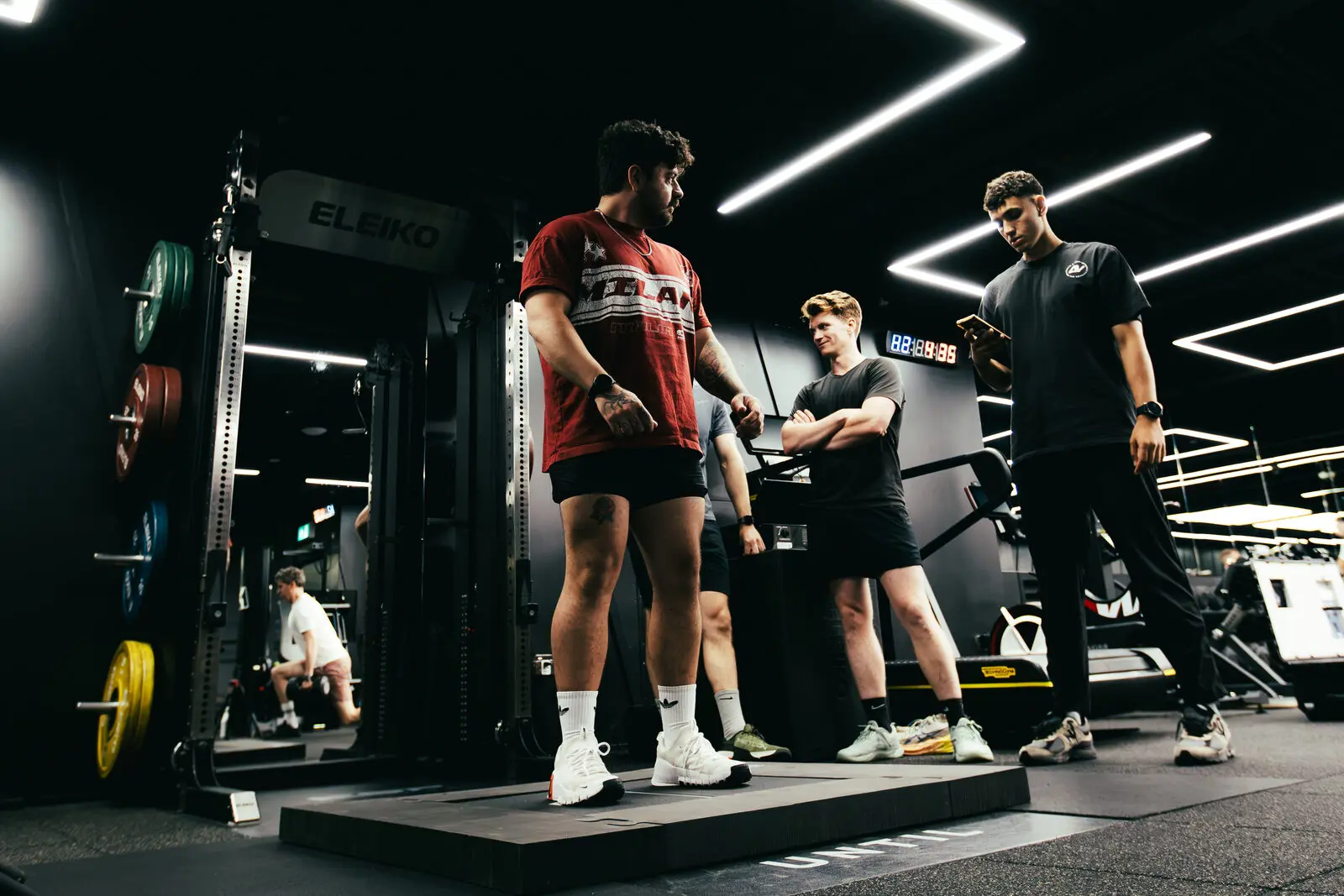
What your body can organise, and what it does when the clock gives it no time to think about it.
Measured with
- Structured movement and position assessment
- Hawkin Dynamics dual force plates — each limb recorded at 1000Hz
- Video capture — so the findings can be seen rather than described
On the day
Session, step by step.
Approximately two hours. The movement assessment runs first, while you are fresh — the force plate protocols are short and maximal, and doing them first would change what the movement assessment found.
- 01
Intake
10 minutes
Your sport and its demands, training history, previous injuries and what you are trying to change. The same finding means different things for a rower and a sprinter.
- 02
Movement assessment
50 minutes
Early and late shoulder and hip measurements, followed by standing strategy analysis, axial compression and reorganisation tests. The findings are interpreted together to identify available relative motion and compensations.
- 03
Force plate protocols
35 minutes
Selected for you from countermovement jumps, reactive and repeated jumps, drop jumps and isometric holds. Short maximal efforts with rest between them.
- 04
Interpretation
25 minutes
The two sets of findings put side by side on screen, and what follows from reading them together. The written report follows.
Athletes whose training keeps meeting the same limitation.
Suited to
- Athletes who want the fullest picture of how they move and how that movement performs under speed
- Anyone whose force plate results raised a question the numbers alone could not answer
- Athletes whose training keeps producing the same limitation despite the programme changing
- Anyone about to commit to a training block and wanting it aimed rather than assumed
- Athletes in sports where how force is produced matters as much as how much
Less suited to
- Anyone seeking a diagnosis or clinical opinion — this is a performance assessment
- Anyone whose question is entirely about endurance physiology; the Endurance Performance Profiling answers that
- Anyone wanting a training programme rather than an assessment and a direction
If you only need one half of this, book that half. The Force & Power Profile at £150 is a genuine standalone assessment, and Biomechanical Assessment at £300 stands on its own too.
Choosing
Compare the three movement and force assessments.
| Assessment | Price | Duration | Measures |
|---|---|---|---|
| Force & Power Profile | £150 | ~1 hour | How you produce force under a time constraint. Braking, propulsion, impulse, velocity, power and limb contribution. |
| Biomechanical Assessment | £300 | ~1 hour | What movement options are available to you and which strategy you rely on to complete a task. |
| Movement & Force Production Strategy Assessment | £400 | ~2 hours | Both, in one appointment, with the force data read against the movement findings rather than beside them. |
| Complete Athlete Profiling | £837 | Two appointments | Resting metabolism, endurance physiology, movement and force production, and sweat and hydration — across two appointments, in one report. |
The combined assessment is £50 less than booking the two separately. If you start with the Force & Power Profile and the findings point deeper, you can move up for a further £250 — the same £400 either way.
Common questions.
The movement assessment combines early and late shoulder and hip measurements, standing strategy, axial compression and reorganisation tests. We use the findings to identify available relative motion and the strategy you rely on. Force plate testing adds measurements of braking, propulsion, timing and limb contribution. Reading both sets of findings together helps us choose training priorities; the combined findings do not establish a single cause for every result.
Yes. Biomechanical Assessment is £300 and the Force & Power Profile is £150. Booked together as one appointment it is £400, so the combined assessment is £50 less than the two bought separately — and the interpretation is what the difference buys.
Yes, for a further £250, which brings your total to the same £400. We will only suggest it where the force plate findings genuinely point towards it — a longer time to take-off, a deeper countermovement than the task needs, a slow transition into propulsion, or a consistent difference between sides worth understanding.
No. It describes how you currently organise movement and how that organisation appears under a time constraint. It is a performance assessment, not a clinical examination: it does not diagnose an injury and it does not predict one. Where something in the findings warrants clinical attention we will say so and point you to the right professional.
No, because that is not a finding. The aim is to understand the strategy you currently rely on, why it may be there, and whether it suits what you are asking your body to do. A strategy that produces a great deal of force when there is time to build it may be well matched to one sport and poorly matched to another that demands short ground contacts. The judgement is always against your demands, never against an ideal.
A written report of the movement assessment, your force-time data, and an interpretation that reads the two together — what your available options are, how they show up under speed, and what follows for exercise selection, positioning, loading, volume and the order in which qualities are worth developing.
Approximately two hours. The movement assessment comes first, while you are fresh, and the force plate protocols follow.
At UNTIL Liverpool Street, 280 Bishops Square, London EC2M 4RB, or UNTIL Marylebone, 1 Orchard Street, London W1H 6HJ. Both by appointment.
Book the Movement & Force Production Strategy Assessment.
- Price
- £400
- Duration
- Approximately 2 hours
- Locations
- Liverpool Street · Marylebone
Included
- Structured movement and position assessment, captured on video
- Full force plate protocols on Hawkin Dynamics dual plates
- One interpretation covering both, not two separate reports
- Training priorities ordered by what the findings support
Where
- UNTIL Liverpool Street280 Bishops Square, London EC2M 4RB
- UNTIL Marylebone1 Orchard Street, London W1H 6HJ
Both sites operate by appointment. Your location is selected when you book.