Endurance testing · London
VO₂ Max & Blood Lactate Testing
A blood lactate test followed by a VO₂ max test, with personalised training zones and a written report to guide your running or cycling.
- Price
- £280
- Duration
- About 90 minutes
- Locations
- Liverpool Street · Marylebone · Canary Wharf
VO₂ max, both threshold systems and your training intensities.
Your report brings the two tests together while keeping lactate and ventilatory thresholds distinct. Use the reviewed pace, power and heart rate zones to plan easy aerobic sessions and harder work. We explain what was measured, what was estimated and how the findings apply to your training.
01VO₂ maxThe highest rate at which your body can take up and use oxygen.
How we measure it
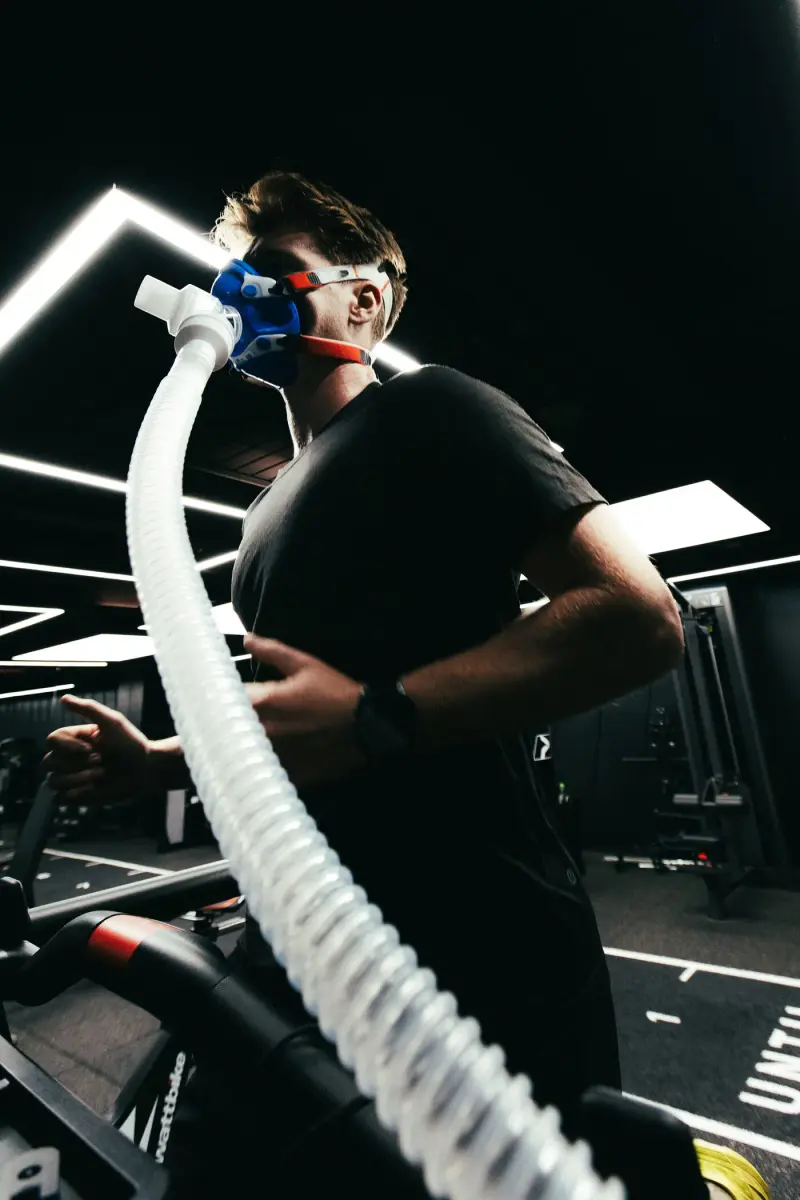
You wear a mask connected to the KORR CardioCoach MAX, which analyses expired gases throughout the maximal test to determine oxygen uptake and carbon dioxide output. Reported in ml/kg/min and L/min alongside the body mass used.
Why it matters
On its own it does not determine endurance performance: the threshold intensities govern the workloads you can hold. It is reported as VO₂ max where maximal effort was established across the whole physiological and performance response, and as VO₂ peak where it could not be. That is not decided by any single criterion.
02LT1, the first lactate thresholdThe first sustained rise in blood lactate above your lower-intensity baseline.
How we measure it
We analyse a fingertip blood sample with the ARKRAY Lactate Pro 2 (LT-1730) at the end of each stage. LT1 is then identified from the shape of your individual curve as the first sustained rise above your lower-intensity baseline, which is an interpretation of those measurements rather than a second measurement. No fixed concentration is used.
Why it matters
In practical terms this marks the upper edge of intensity for long, low-stress work. If easy sessions regularly sit above this intensity, they may accumulate more physiological stress than intended.
03LT2, the second lactate thresholdEstimated from the shape of your individual lactate curve.
How we measure it
LT2 is estimated from the shape of the individual lactate curve using Modified Dmax and reviewed against the measured response. The speed and heart rate at that point are read from the test; where the estimate falls between two measured stages they are interpolated, and your report says so.
Why it matters
Tempo, threshold and interval work is set from it. This is an estimate from an incremental profile, not a maximal lactate steady state: establishing the highest constant workload at which lactate remains stable requires repeated constant-load trials on separate days, which this assessment does not include.
04VT1 and VT2, the ventilatory thresholdsDetected from the ventilatory response during the maximal test.
How we measure it
The analyser locates VT1 and VT2 from the ventilatory equivalents. These are detected landmarks from a different signal than the lactate thresholds, their positions depend on the detection method, and they are reported as ranges and separately from LT1 and LT2.
Why it matters
Two threshold systems, each collected under a protocol built for it. They often sit near one another. Where they separate, the report says so and the difference is interpreted against your event and training rather than averaged into one number.
05Measured maximum heart rateThe highest heart rate recorded during the maximal test.
How we measure it
Heart rate is recorded continuously from a chest strap, so the reported figure is the highest you reached in this protocol and this mode.
Why it matters
Age-based equations carry a population standard deviation of roughly ten to twelve beats, and individuals fall further out than that. Your zones are built on the figure recorded rather than on an estimate.
06Training zones in your own unitsDerived and reviewed, not measured.
How we measure it
The CardioCoach MAX generates an initial set of zones using its configured anaerobic-threshold model. DVOTION then reviews those against the threshold positions, the heart-rate response and the full test response, with the blood lactate profile providing additional information for that review.
Why it matters
Your report expresses intensity in the units you use in training: heart rate alongside running speed or cycling power. Each provides different information depending on the session, modality and conditions. Heart rate suits longer steady work but responds with a delay and shifts with heat, fatigue and hydration. Running speed is straightforward on consistent terrain. Cycling power responds immediately to a change in external workload.
07Your reportReviewed on screen the same day, written version by email.
How we measure it
Your lactate curve with LT1 and LT2 marked, the respiratory data alongside it, a zone table, and what the findings suggest for training.
Why it matters
We explain what your results mean for your training, including which values were measured and which were estimated. You can share the report with your coach.
About 90 minutes for both tests and a discussion of your results.Your assessment is run by Chris Gkoufas and Aris Myrkos.
- 01IntakeYour event, training week and recent load. Your starting speed is set from this rather than from a default, and deliberately low enough to collect several stages before lactate begins to rise.
- 02Warm-upEasy treadmill running at a 1% gradient, then the heart-rate strap and sampling kit. No mask for the first test.
- 03Lactate profileSpeed rises by 1 km/h in three-minute stages at a 1% gradient. At the end of each you straddle the belt for about thirty seconds for a fingertip sample, then start the next. It continues until your second threshold has clearly been passed and there are enough stages above it to resolve the curve, rather than to exhaustion.
- 04RecoveryA deliberate recovery interval, long enough to clear the first test without letting you go cold before the second.
- 05VO₂ max testThe mask goes on. Your starting speed is selected from the lactate profile so the maximal phase is targeted to approximately 8 to 12 minutes. Speed then rises by 1 km/h every minute at a 1% gradient to volitional exhaustion, with no sampling interruptions. Afterwards we ask for your rating of effort and whether you felt you had meaningful capacity left.
- 06Review and reportYour lactate curve, both threshold systems and your aerobic capacity on screen before you leave. Your written report is sent by email within 24 hours of your assessment.
Choosing
Choose lactate, VO₂ max or both.
- VO₂ Max Test £160
1 hour · Gas exchange only: VO₂ max, VT1, VT2, measured HRmax and training zones. No blood sample.
1 hour · Staged blood lactate testing with LT1 and LT2 interpretation and heart-rate and pace or power zones. No VO₂ max test or gas analysis.
- Endurance Performance ProfilingThis one£280
About 90 minutes · A blood lactate profile with LT1 and LT2, then a separate maximal test for aerobic capacity and the ventilatory responses.
About 3 hours · Biomechanical analysis including force-plate testing, followed by VO₂ max and blood lactate analysis in one appointment lasting about three hours.
Blood Lactate Analysis and the VO₂ Max Test can each be booked on their own. Combined Endurance Performance Profiling includes both tests for £280, saving £40 compared with booking them separately. Complete Athlete Profiling adds biomechanical analysis and force-plate testing in the same appointment, lasting about three hours in total.
Training for a specific event?
The assessment is the same whatever you race. What changes is which numbers matter most and when it is worth testing.
Questions we get asked.
Your written report is sent by email within 24 hours of your assessment.
Endurance Performance Profiling costs £280 at DVOTION Labs in London and takes about 90 minutes. It includes a staged blood lactate profile, a separate maximal test with gas analysis, a discussion of your results and a written report with training zones and recommendations.
VO₂ Max Testing at £160 measures aerobic fitness and uses ventilatory thresholds to guide training zones. Endurance Performance Profiling at £280 adds a staged blood lactate profile before a separate maximal test. Choose the combined assessment if you want a lactate curve and LT1 and LT2 estimates alongside your aerobic fitness results.
Commonly 10 to 14 weeks out, which leaves time to train on the zones. Testing in the final fortnight still measures accurately but leaves little opportunity to act on it.
The one you train and compete in. Zones do not transfer cleanly between running and cycling, so triathletes wanting accurate zones for both usually test each separately, a week or more apart.
Yes. The Endurance Performance Profiling protocol adapts to the intensity you can produce, and the zones are individual either way. The relevant question is whether you train to a structure the zones can inform.
Eat normally beforehand and finish your last meal approximately four hours before your assessment. Water is allowed. Avoid deliberately changing your usual carbohydrate intake before testing: pre-test nutritional state can alter the blood-lactate response at a given workload, so standardising it is what makes two assessments comparable. Arrive well hydrated and well rested, avoid intense training the day before, and bring the kit and shoes you train in. If you are retesting, replicate your previous pre-test meal and its timing as closely as practical.
Resting metabolic rate is not included in Endurance Performance Profiling. Book the standalone RMR assessment if you want a resting energy measurement. RMR is also separate from Complete Athlete Profiling.
For many training blocks, around 12 to 16 weeks is a useful interval, but the right timing depends on what you are trying to change, the training phase you are in and whether the retest is likely to affect a decision. Shorter or longer intervals can also be appropriate. Any change needs to be interpreted alongside test preparation, the protocol and normal day-to-day variation.
Yes. Endurance Performance Profiling is a standalone service. You receive your zones, thresholds and report and are free to apply them yourself or pass them to your own coach.
DVOTION Labs offers testing at UNTIL Liverpool Street, 280 Bishopsgate, London EC2M 4RB; UNTIL Marylebone, 1 Orchard Street, London W1H 6HJ; or UNTIL Canary Wharf, 30 South Colonnade, London E14 5HX. All three operate by appointment.
Book an endurance assessment.
- Price
- £280
- Duration
- About 90 minutes
- Locations
- Liverpool Street · Marylebone · Canary Wharf
Where
- UNTIL Liverpool Street280 Bishopsgate, London EC2M 4RB
- UNTIL Marylebone1 Orchard Street, London W1H 6HJ
- UNTIL Canary Wharf30 South Colonnade, London E14 5HX
All three sites operate by appointment. Your location is selected when you book.
Still deciding which one?
Tell us your event and what you want to understand, and we will reply with a recommendation.