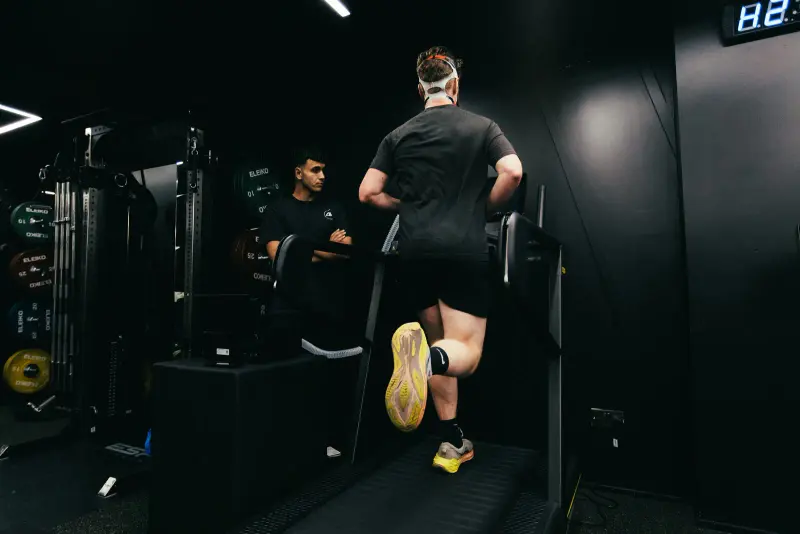
Metabolic assessment · London
VO₂ Max Test in London
Measure your aerobic fitness and understand how your body responds at different exercise intensities.
VO₂ max testing measures your body's ability to take in and use oxygen during exercise, giving you an objective measure of aerobic fitness. As intensity increases, we also identify your ventilatory thresholds and how your use of fat and carbohydrate changes.
- Price
- £160
- Duration
- 1 hour
- Locations
- Liverpool Street · Marylebone
VO₂ max, ventilatory thresholds and training zones.
Your results are used to establish individual heart rate training zones, giving you specific intensities for easier aerobic work, harder training and everything in between. Repeat testing can then show whether your aerobic fitness and physiological response to the same workloads are improving.
01VO₂ maxThe highest rate at which your body can take up and use oxygen.
How we measure it
You wear a mask connected to the CardioCoach MAX, which analyses expired gases throughout the incremental test to determine oxygen uptake and carbon dioxide output. Reported in ml/kg/min and L/min alongside the body mass used.
Why it matters
Reported as VO₂ max where maximal effort was established across the whole physiological and performance response, and as VO₂ peak where it could not be. That is not decided by any single criterion: a levelling-off in oxygen uptake contributes to the judgement, as do your rating of effort afterwards, whether you tell us you had meaningful capacity left, and how your physiology responded through the test. VO₂ max is a benchmark to retest against. The ventilatory thresholds are what set your session intensities.
02VT1, the first ventilatory thresholdThe first ventilatory transition, above which the response to rising workload begins to change.
How we measure it
The analyser locates VT1 from the ventilatory equivalents, at the first point where ventilation rises disproportionately to oxygen uptake. It is a detected landmark rather than a directly measured value, its position depends on the detection method, and it is reported as a range.
Why it matters
In practical terms this marks the upper edge of intensity that can be sustained for long, low-stress work. If easy sessions regularly sit above this intensity, they may accumulate more physiological stress than intended.
03VT2, the second ventilatory thresholdA higher-intensity ventilatory transition, beyond which physiological disturbance develops more rapidly.
How we measure it
The analyser flags VT2 where the ventilatory equivalent for oxygen continues rising after VT1 has been passed. Also a detected landmark, method-dependent, and reported as a range.
Why it matters
Above this intensity, physiological disturbance develops more rapidly and exercise tolerance progressively decreases. Tempo, threshold and interval work is set from it. Both ventilatory thresholds sit within a range rather than at one exact number, and your report gives them that way.
04Measured maximum heart rateThe highest heart rate you reached during the test.
How we measure it
Your heart rate is recorded throughout, so the highest figure is the one you reached, rather than one worked out from your age.
Why it matters
The usual 220-minus-age formula can be out by 10 to 20 beats for any given person. Your zones are built on the heart rate you reached.
05Training zonesDerived and reviewed, not measured.
How we measure it
The CardioCoach MAX generates an initial set of zones using its configured anaerobic-threshold model. DVOTION then reviews those zones against the threshold positions, the heart-rate response and the full test response before they are reported.
Why it matters
Your report expresses intensity in the units you use in training: heart rate alongside running speed or cycling power. Each provides different information depending on the session, modality and conditions. Heart rate suits longer steady work but responds with a delay and shifts with heat, fatigue and hydration. Running speed is straightforward on consistent terrain. Cycling power responds immediately to a change in external workload.
06Estimated fuel use across exercise intensitiesHow your reliance on fat and carbohydrate changes as intensity rises.
How we measure it
Estimated from the respiratory exchange ratio, the ratio of carbon dioxide produced to oxygen consumed, recorded at every stage. Carbon dioxide has to be measured for this; an analyser that records oxygen alone cannot produce it.
Why it matters
The gas data shows how the estimated balance between fat and carbohydrate changes as exercise intensity rises, and the point at which carbohydrate contribution begins to rise substantially. Because this is a short-stage maximal protocol rather than a dedicated substrate-oxidation test, the fuel-use response is treated as contextual information rather than a formal FatMax measurement. The estimate also assumes the carbon dioxide leaving you came from metabolism, and at high intensity a growing share comes from buffering instead, so the balance is reported for the submaximal stages and not above VT2.
07Peak ventilationThe highest volume of air you moved per minute during the test.
How we measure it
Recorded in litres per minute across the whole protocol. Ventilation is the signal the ventilatory thresholds are identified from, so the peak is reported alongside them as the top of the response they sit within.
Why it matters
Wearing a mask adds some resistance to breathing and can change the pattern slightly, which is one reason the same protocol and setup are used at every retest.
08Your reportReviewed on screen the same day, written version follows.
How we measure it
A one-page summary, your full gas data with both ventilatory thresholds marked, your fuel-use curves, and a table of your zones with the protocol they were produced under.
Why it matters
We go through it on screen before you leave, and the written version follows. It also flags the two or three numbers worth watching if you test again later.
This assessment measures the ventilatory thresholds from gas exchange. It does not include blood lactate sampling. Endurance Performance Profiling costs £240 and includes a staged blood lactate profile followed by a separate maximal test with gas analysis. Your report explains the lactate and ventilatory thresholds separately.
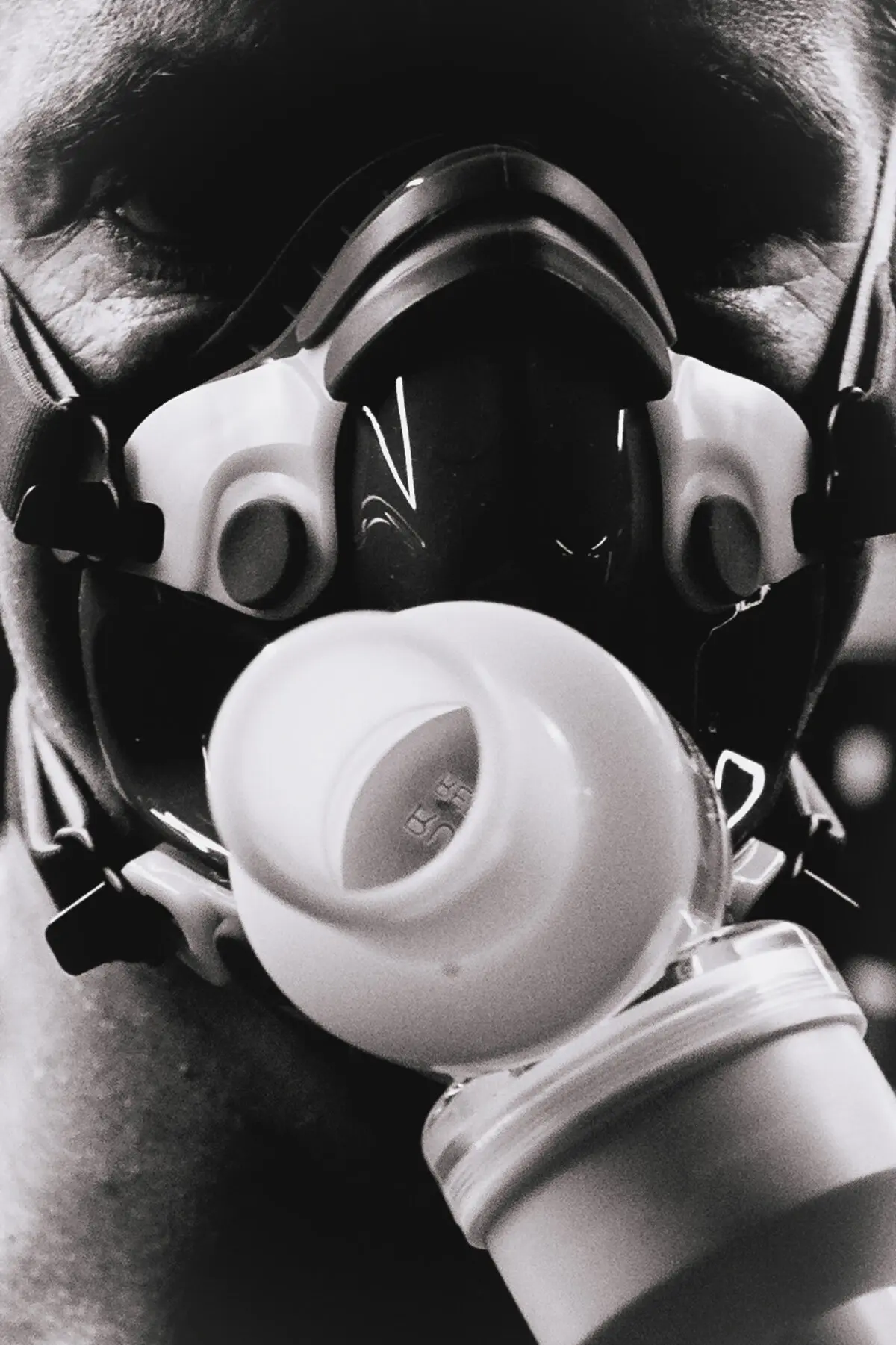
Your report uses your own test response to explain the training zones and any limits in the findings.
Measured with
- KORR CardioCoach MAX for expired gas analysis
- Treadmill or cycle ergometer, so you test in the mode you train in
- Heart-rate strap, recording your maximum heart rate throughout
The appointment takes approximately 60 minutes from arrival to leaving.
- 01IntakeTraining history, current weekly load and your target event. Your starting speed is chosen from this so the incremental phase is expected to reach maximal effort in roughly eight to twelve minutes. It is not the same starting speed for everyone.
- 02SetupThe metabolic analyser is calibrated for gas and flow. Mask fitted and heart-rate strap applied.
- 03Warm-upEasy treadmill running at a 1% gradient. A standardised 1% gradient partly accounts for the absence of air resistance during indoor running and keeps conditions consistent between your assessments.
- 04Incremental phaseSpeed increases by 1 km/h every two minutes at a constant 1% gradient, and the test runs to volitional exhaustion. Holding each speed for two minutes lets your heart rate come close to what that speed demands, so the heart rate paired with each pace is one you would hold there rather than one still climbing. The CardioCoach MAX analyses expired gases throughout, so your ventilatory thresholds and fuel-use response are derived from the whole test rather than only from the top of it.
- 05ReviewAfterwards we ask for your rating of effort and whether you felt you had meaningful capacity left. Your curve, thresholds and zones are then reviewed on screen with you before you leave.
- 06Written reportThe full report follows by email with the complete data set, your zones and recommendations.
Runners, cyclists and triathletes in structured training.
Suited to
- Runners and cyclists who train to a structure and want zones based on measured values
- Triathletes who need zones established separately for each discipline
- Athletes preparing for a specific event who want a baseline before the training block begins
- Athletes whose progress has flattened despite consistent training
- Anyone whose current zones were set from an age-based formula or a field test
- Athletes retesting to establish whether a block has produced measurable change
Less suited to
- Anyone not currently training to a structure, since the zones will be accurate but there may be little to apply them to
- Athletes who want movement or force-production information, which this assessment does not cover
If you are unsure whether this or the Complete Athlete Profiling assessment fits what you want to understand, ask before booking.
Treadmill or bike
Treadmill or bike, whichever you train in.
Treadmill
Produces zones expressed in running speed alongside heart rate. Appropriate for runners, and for triathletes establishing their run zones.
Running recruits a large muscle mass and typically produces a higher VO₂ value than cycling in athletes who are not primarily cyclists.
Cycle ergometer
Produces zones expressed in cycling power alongside heart rate. Appropriate for cyclists, and for triathletes establishing their bike zones.
Power is measured directly, which makes cycling zones straightforward to apply to structured sessions and to an indoor trainer.
Zones do not transfer cleanly between modes. Test in the discipline you are training for. Availability of each mode is confirmed when you book.
Questions we get asked.
The VO₂ Max Test costs £160 at DVOTION Labs in London. Allow 1 hour for the appointment. The price includes the assessment, a discussion of your results and a written report with training zones and recommendations. Blood lactate testing is included in Endurance Performance Profiling at £240.
Yes. You can book a VO₂ max test without buying coaching from DVOTION. Your written report includes the test findings, training zones and recommendations to use yourself or share with your coach.
DVOTION offers treadmill and cycle testing. Choose the discipline you train in, because running and cycling zones can differ. Availability of the testing mode is confirmed when you book. A triathlete wanting both run and bike zones needs a separate assessment for each discipline.
Eat normally beforehand and finish your last meal approximately four hours before your assessment. Water is allowed. Avoid deliberately changing your usual carbohydrate intake before testing. Arrive well hydrated; normal fluid intake through the day before is enough. Avoid intense training the day before: the assessment measures your response, and arriving fatigued measures fatigue. Wear the kit and footwear you train in. If you are retesting, replicate your previous pre-test meal and its timing as closely as practical.
The protocol is progressive: it begins at a comfortable intensity and increases in stages. Most of the assessment is not maximal. The final stages are hard, and the clearest VO₂ max value comes from reaching a genuine maximal effort, but the test can be stopped at any point.
Ventilatory thresholds may still be identified if the completed stages capture the relevant response. Stopping earlier can limit the findings and the training zones we can report. What may not be established is a confirmed VO₂ max. The result is reported as VO₂ max where maximal effort was established across the whole physiological and performance response, and as VO₂ peak where it could not be. That is not decided by any single criterion, and the distinction is stated in your report.
Yes. The analyser generates an initial set of zones using its configured anaerobic-threshold model, and we review those against your threshold positions, your heart-rate response and the full test response before they are reported. They are derived and reviewed rather than measured, and they come from your own assessment rather than from an age-based formula or a percentage of an estimated maximum.
The standalone VO₂ Max Test uses gas analysis and does not include blood sampling. Endurance Performance Profiling costs £240 and includes a staged blood lactate profile followed by a separate maximal test with gas analysis. Lactate and ventilatory thresholds are reported separately.
Yes. The protocol adapts to the intensity you can produce, and the resulting zones are individual either way. What matters is whether you intend to use the zones. If you are not currently training to a structure, the measurements will be accurate but you may have little to apply them to.
For many training blocks, around 12 to 16 weeks is a useful interval, but the right timing depends on what you are trying to change, the training phase you are in and whether the retest is likely to affect a decision. Shorter or longer intervals can also be appropriate. Any change needs to be interpreted alongside test preparation, the protocol and normal day-to-day variation.
DVOTION Labs offers testing at UNTIL Liverpool Street, 280 Bishops Square, London EC2M 4RB, or UNTIL Marylebone, 1 Orchard Street, London W1H 6HJ. Both are by appointment.
Book VO₂ max testing.
- Price
- £160
- Duration
- Approximately 60 minutes
- Locations
- Liverpool Street · Marylebone
Where
- UNTIL Liverpool Street280 Bishops Square, London EC2M 4RB
- UNTIL Marylebone1 Orchard Street, London W1H 6HJ
Both sites operate by appointment. Your location is selected when you book.